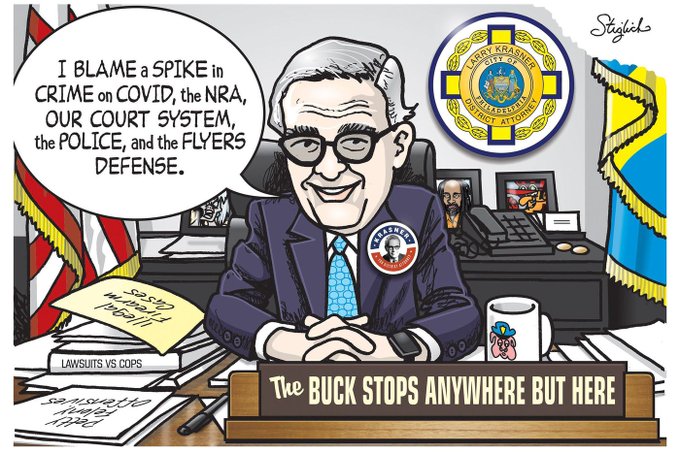
If the gun laws are the problem, why aren’t the homicide rates for Philly and the rest of the Commonwealth fairly similar?

It was no surprise that six more murders occurred in the City of Brotherly Love over the weekend, including Friday. Since the Philadelphia Police Department’s Current Crime Statistics page is not updated on Saturday or Sunday, we don’t get Friday’s ‘official’ numbers until Monday morning, though this tweet let me know earlier that the carnage was on.

Well, it was 10:45 AM EDT on Monday morning as I began, and as always, I checked our nation’s third oldest continuously published daily newspaper, the 17th largest in terms of circulation, The Philadelphia Inquirer, to check their coverage.

4-year-old shot in Olney barbershop

The child was struck by a single round following an argument. He is currently hospitalized and in stable condition.

by Ryan W Briggs | Sunday, August 28, 2022

A 4-year-old was wounded by gunfire following an altercation at a barbershop in the city’s Olney section — the latest of nearly 150 minors shot in Philadelphia this year.

The boy — whom police are not identifying because of his age — was with his father getting a haircut at a barbershop on the 5000 block of Rising Sun Avenue on Sunday afternoon. About 5:15 p.m., police say, they believe another patron got involved in an unrelated argument, pulled a gun, and opened fire inside the tiny salon.

Police say the boy was struck once in the right shoulder. Medics took the boy to nearby Einstein Medical Center, and he was then transferred to the Children’s Hospital of Philadelphia and placed in stable condition.

No weapon was recovered and no arrests had been made. Police are now reviewing surveillance footage.

There’s more at the original, but it’s a story about a young boy shot, but not killed. It was also the only story on either the Inquirer’s website main page or specific crime page I could find on any of the weekend shootings. Oh, there was a week-old story about 2 killed, 1 shot in Midtown neighborhood, from Atlanta, Georgia, and Oklahoma sheriff deputy serving eviction papers shot, killed, along with several other, older stories, but not one single word about the six Philadelphians who spilled out their life’s blood on the city’s mean streets.

I’ll be blunt here: none of the six slain could have been non-Hispanic whites, because, as we noted on Saturday, the newspaper which publisher Elizabeth Hughes vowed to make “an antiracist news organization” provides plenty of coverage when white guys get killed, but mostly ignores homicides when the victims are black, because to cover that would reinforce stereotypes that blacks are responsible for a disproportionate amount of crime.

Of course, readers already know that, and mostly assume that both victims and perpetrators of murder in Philly are black, unless told otherwise. There really are no secrets being kept here.

However, while the Philadelphia Police Department report six killed, the city’s shooting victims database tells me that nine people were shot to death over Friday, Saturday, and Sunday, August 26th through 28th. The nine fatal shootings,[1]The embedded link will take you to the city’s original. However, the city’s chart is formatted horribly, so I downloaded it and pasted it into a Microsoft Excel file, hid some columns and … Continue reading highlighted in yellow, include seven black males and two Hispanic white males.

It is possible that three of those killed were shot in self-defense, or some other justifiable situation, which could explain the discrepancy between the database and the Police Department’s numbers.

The Editorial Board of the Inquirer likes to blame a lack of gun control laws for the increased killings:

Lawmakers in Philadelphia have long tried to pass gun safety measures, only to get rebuffed by state courts and the recalcitrant Republican-controlled legislature in Harrisburg. Just last week, a majority-Republican panel of the Pennsylvania appeals court rejected Philadelphia’s latest attempt to overturn the state law that prevents the city from enacting its own gun regulations.

Mayor Jim Kenney rightly said the city would appeal the wrongheaded decision to the Pennsylvania Supreme Court.

There we have the Editorial Board telling us that Philadelphia is under the same gun control laws as the rest of Pennsylvania.

In 2020, there were 1,009 murders in the Keystone State, 499, or 49.45%, of which occurred in Philadelphia. According to the 2020 Census, Pennsylvania’s population was 13,002,700 while Philadelphia’s alone was 1,603,797, just 12.33% of Pennsylvania’s totals.

Here’s how the actual numbers work out: there were 510 homicides among 11,398,903 Pennsylvanians not living in Philadelphia, for a homicide rate of 4.474 per 100,000 population, while there were 499 murders among 1,603,797 Philadelphians, which works out to a homicide rate of 31.114 per 100,000. If the gun laws are the problem, why aren’t the homicide rates for Philly and the rest of the Commonwealth fairly similar?[2]Even as late as the end of August, I have been unable to find the ‘official’ statistics for the number of homicides statewide for 2021. With 562 murders in Philly in 2021, I’m sure … Continue reading

Yeah, I know: math has now been deemed racist by some on the left, but numbers are numbers, and the math is really pretty simple. The problem is not the gun laws; the problem is something specific to Philadelphia and our other large, urban areas.

References

References
1 The embedded link will take you to the city’s original. However, the city’s chart is formatted horribly, so I downloaded it and pasted it into a Microsoft Excel file, hid some columns and moved others, so the reader could see the data in an easier to read format.
2 Even as late as the end of August, I have been unable to find the ‘official’ statistics for the number of homicides statewide for 2021. With 562 murders in Philly in 2021, I’m sure the statistical disparities would be even worse, but I cannot work with numbers I do not have available.

If “Black Lives Matter,” why do black killers of white victims get more severe sentences than black killers of black victims even in very liberal cities?

Josephus Davis, photo via WPVI-TV, Click to enlarge.

“It’s a shame that another Black male, young male, is losing his life to the system,” Josephus Davis said. “It’s another white judge, white family, white DA, and another Black male.”

‘You will die in prison’: Philadelphia man is sentenced to life in prison for murder of Brewerytown man walking his dog

Josephus Davis, 21, was convicted in the murder of Milan Loncar, who was fatally shot while walking his dog in Brewerytown last year.

by Ellie Rushing | Friday, August 26, 2022

After an emotional two-hour hearing that brought even a seasoned homicide prosecutor to tears, a Philadelphia man on Friday was ordered to spend the rest of his life in prison for fatally shooting a man as he walked his dog in Brewerytown last year.

Josephus Davis, 21, was convicted of second-degree murder, robbery, and related offenses in June for the killing of Milan Loncar, 25, a Wayne native and Temple University graduate. Loncar was walking his dog after work in January 2021 when Davis and another man held him at gunpoint in an attempted robbery. After rifling through his pockets, Davis shot Loncar in the chest, then ran away as Loncar lay bleeding on the street.

Think about that: after robbing Mr Loncar, when there was absolutely no need to do so, Mr Davis shot and killed his victim anyway, but, “It’s a shame that another black male, young male, is losing his life to the system.” Perhaps, just perhaps, it was Mr Davis who took the decision to spend the rest of his miserable life in jail, not that “white judge, white family, (and) white DA.”

During Friday’s sentencing hearing, Common Pleas Court Judge Barbara A. McDermott read segments of the approximately 25 letters submitted by family and friends detailing how Loncar’s death has affected their lives. All described him as caring and loving, “the best person [they’d] ever met.”

Jelena Loncar, 28, said she has not been able to work more than 20 hours per week since her brother’s death. She sold her house in Brewerytown after the shooting and, along with other family and friends, moved out of Philadelphia, the pain and fear of the ongoing violence crisis too much to bear.

Ellie Rushing, The Philadelphia Inquirer reporter, went through some time and effort to tell us how loved Mr Loncar was by his family and friends, but there’s a certain point which arose in my mind: yes, Mr Loncar may have been a wonderful guy, but does that mean his life was somehow worth more than the lives of many of the thugs who’ve also been killed in the City of Brotherly Love? We have previously noted how Fayette County Commonwealth’s Attorney Lou Anna Red Corn “mediated” crimes and allowed lenient plea deals and sentences for murderers — I suppose “manslaughterers” would be a more mocking term for their crimes now — and if that happened in the Bluegrass State rather than Philadelphia, the same things are happening all around the country in our cities. Of course, in those Lexington cases, the murdered manslaughtered men were black gang members as well, while Mr Loncar was white.

And even as Davis maintained his innocence, and his mother testified of his traumatic childhood filled with abuse and instability, Judge McDermott was firm in meting out his punishment.

“You will die in prison,” she said.

McDermott sentenced Davis to life in prison without the possibility of parole, the mandatory sentence in Pennsylvania for second-degree murder.

Jelena Loncar, left, with her brother Milan Loncar, in December 2020 outside of Tinsel bar in Center City.
Courtesy of Jelena Loncar, via The Philadelphia Inquirer. Click to enlarge.

Of course, Mr Davis chose to fight the charges in a jury trial, and was convicted. Had that not happened, District Attorney Larry Krasner would probably given him a nice, soft plea bargain. Ahhh, but then again, the very black Mr Davis killed a white victim, generating the kind of sympathy that the murder of Samuel Collington,  a Temple University student approaching graduation. Mr Collington was a white victim, allegedly murdered by a black juvenile in a botched robbery. Then the Inquirer published 14 photographs from a vigil for Mr Collington, along with another story about him. Five separate stories about the case of a murdered white guy.

The Inquirer even broke precedent when it came to Mr Collington’s murder by including the name of the juvenile suspect in the case, and delving into his previous record.

The Inquirer, a newspaper which publisher Elizabeth Hughes vowed to make “an antiracist news organization”? I see that the paper paid more attention to the accidental killing of Jason Kutt, a white teenager shot at Nockamixon State Park, an hour outside of the city. That’s five separate stories, a whole lot more than the two or three paragraphs most victims get.

Let me be clear here: I absolutely support the sentence Mr Davis received, and it’s a good thing that state law sets life in prison without the possibility of parole as being mandatory for second-degree murder; no judge should have any leeway in that. What I oppose is the lenient plea bargain deals which let murders off with manslaughter convictions, meaning that they can see a time at which they will be released, and, all too frequently, are eligible for early parole. Murders should not get out of prison until the day that their victims come back to life!

It seems that this was not Mr Davis first brush with the law:

Prosecutors, though, said the evidence was clear: As Loncar walked his dog, Roo, near 31st and Jefferson Street that January evening — two blocks from his residence, and a half-block from Davis’ — Davis and an accomplice attacked him.

So, both murderer and his victim were neighbors, living in an integrated area. Zillow shows me an area of mixed housing, some older and in not the greatest repair, while other residences have been fixed up and selling well into the $300,000 range.

Later that night, Davis was stopped by police in Kensington after officers recognized the car he was in as having been reported stolen in a carjacking the day before. Davis and a few other men hopped out and ran, Assistant District Attorney Joanne Pescatore said.

When police caught and questioned Davis, he wore a distinctive belt and shoes — evidence prosecutors used to match him to surveillance video of Loncar’s murder. Police later tested Davis’ clothes for ballistics evidence and found a small amount of gunshot residue on one of his jackets. The accomplice has not been identified.

Davis, one of 14 children, spent most of his life in the system, family testified. His mother said he was taken from her, along with his siblings, when he was 8, and forced to live with his father, who struggled with addiction and homelessness. Davis was arrested for the first time at 14 for assault, and bounced between numerous behavioral health facilities through his childhood. When he was 12 years old, his mother said, Davis witnessed a facility staffer fatally beat another child.

“You all think he is a monster,” she said. “But the streets turned him that way.”

Well, perhaps his mother being such a rotten parent that the Commonwealth took her children away from her might have had something to do with it, and not just “the streets.”

Davis’ crimes continued into adulthood. He was arrested four times for robbery and aggravated assault, the judge said. He was on probation for robbery at the time of the murder, and was awaiting trial on charges of carjacking and assaulting a jail guard. He had been released from jail two weeks before killing Loncar.

Mr Davis has two brothers also locked up, so it’s a criminal family, which makes me wonder: was he treated leniently by the District Attorney in a manner which allowed him out of jail two weeks before he killed Mr Loncar? Could Mr Davis have been behind bars on January 13, 2021, the day he robbed and killed Mr Loncar? If he could have been behind bars on that date, did the legal system, did the District Attorney, do him any favors by letting him out early? The 21-year-old Mr Davis might have been looking at several more years behind bars, but at least be able to see, into the future, when he would get out. But because he was out, and able to kill someone, he will only be freed when he has been freed from this mortal life.

I can have some sympathy for Mr Davis, in that he grew up without much of a chance. Saying that he was “forced to live with his father” is the same thing as saying that his father did not live with his mother. Somehow, some way, Western culture has decided that the primary organizational structure of every human society of which we have any knowledge, for as far back into history as we can determine social structure, normal, heterosexual marriage, with both fathers and mothers living together and rearing their children together, is just so much junk, and can be blithely discarded, leaving people like Mr Davis’ mother alone to bring up 14 kids. We have allowed our own selfishness to ruin things for everyone.

But having some sympathy for Mr Davis does not mean that I think his crimes should be excused or minimized: he killed another man, and were he somehow freed, he’d wind up killing someone else. I can hope that he finds God in prison, and that his life after this one will be better.

The problem is not mass incarceration; the problem is that not enough people have been incarcerated, for not enough time

We noted, on April 6th, that John George Boulder IV, De’Shaun Quantrell Armor, Sevion Mitchell and Kenneth Jakobe Jackson, who murdered two 18-year-olds, Dwayne Slaughter and Darrian Webb because Messrs Slaughter and Webb allegedly made “disparaging remarks” about a dead member of Messrs Boulder’s, Mitchell’s and Jackson’s drug gang.

Suspects accused of killing 2 men in a Lexington gang retaliation take plea deals

by Jeremy Chisenhall | Wednesday, April 6, 2022 | 6:00 AM EDT

John George Boulder IV, photo by Fayette County Detention Center, and is a public record. Click to enlarge.

Four men have pleaded guilty to reduced charges for their involvement in a deadly daylight shooting that Lexington prosecutors say was a gang retaliation.A Lexington gang planned to retaliate against two 18-year-olds because members of the group believed those two made “disparaging remarks” about a dead gang member, according to court records. Dwayne Slaughter and Darrian Webb, both 18 years old, died in the shooting on Oct. 19, 2019. All four suspects entered guilty pleas in Fayette Circuit Court Friday.

Three of the men who pleaded guilty in the deadly shooting are among the 14 people who have been indicted in a related organized crime case, according to court records. The fourth suspect hasn’t been criminally connected to the gang but was accused by a witness of being part of the same group.

The shooting happened on Oct. 19, 2019, at the intersection of Winchester Road and Seventh Street. De’Shaun Quantrell Armor, Sevion Mitchell and Kenneth Jakobe Jackson were in a vehicle driven by John George Boulder IV when they pulled up behind a vehicle with the two victims inside, according to court records.

Armor, Mitchell and Jackson were all armed, according to court records. The suspects opened fire and dozens of shots rang out in the middle of the intersection, leaving Slaughter and Webb dead, according to court records. A third person in the victims’ vehicle was injured but didn’t die.

There’s much more at the linked original; the mugshots were not included in the Lexington Herald-Leader original, but at The First Street Journal, we look up the information and publish it.

Sevion Mitchell, photo by Fayette County Detention Center, and is a public record. Click to enlarge.

These are some bad dudes! The Fayette County Detention Center had not one but six mugshots of Mr Boulder, from six separate arrests, the first dated September 9, 2017, not quite four months after his 18th birthday. Mr Armor had two previous mug shots shown.

Messrs Armor, Mitchell and Jackson were each charged with two counts of murder when they were first indicted, while Mr Boulder, who was not armed at the time of the killings, was charged with facilitating murder. Following ‘mediation’ to work out a plea deal, Mr Armor pleaded guilty to two counts of manslaughter as well as to charges of evidence tampering and evading police; other charges were dismissed. Prosecutors recommended that he be sentenced to seven years in prison for each manslaughter count and one year for each of his tampering and evading convictions. No recommendation was made as to whether the sentences should run consecutively or concurrently.

De’Shaun Quantrell Armor, photo by Fayette County Detention Center, and is a public record.

Mr Armor pleaded guilty to two counts of manslaughter, as well as one count each of tampering with evidence and evading capture. Prosecutors recommended seven years in prison for each manslaughter count and one year for each of his tampering and evading convictions.

Messrs Mitchell and Jackson, who were juveniles, 17, when the killings occurred, each pleaded guilty to two counts of manslaughter, with other charges against them dismissed, and the prosecution recommended that both be sentenced to seven years for each of their manslaughter convictions; again, no recommendation was made concerning whether the sentences run consecutively or concurrently.

According to reporter Jeremy Chisenhall’s story, the shooting in the middle of an intersection, at busy Winchester Road and Seventh Street, by a Speedway gasoline station and mini-mart, left 37 shell casings recovered by investigators; these guys were firing and endangering more than just the two 18-year-old rival gang members, but bullets could have struck innocent bystanders as well.

Well, now these four fine gentlemen have been sentenced, though two months later than their originally reported sentencing date.

4 men sentenced to prison after pleading guilty to shooting that left 18-year-olds dead

by Taylor Six | Thursday, August 25, 2022 | 3:50 PM EDT

Kenneth Jackson, photo by Fayette County Detention Center, and is a public record. Click to enlarge.

Armor was sentenced to 14 years after pleading guilty to two counts of second-degree manslaughter, with the other charges of assault, criminal mischief, tampering with physical evidence and wanton endangerment being dismissed. He was sentenced to seven years for each manslaughter charge and his sentences will run consecutively. He was credited for more than two and a half years of time already served.Jackson was sentenced to 12 years in prison after pleading guilty to two counts of second-degree manslaughter. He was sentenced for seven years on one conviction, and five years on the other conviction, which also carries a concurrent sentence of two years.

Jackson entered an “Alford Plea,” meaning he doesn’t admit guilt, but agrees there is enough evidence that a jury could find him guilty. The remaining charges he faced were dismissed. Jackson was credited for just over two years of time already served Armor and Jackson were originally charged with two counts of murder, first-degree assault, first-degree criminal mischief, tampering with physical evidence, and first-degree wanton endangerment.

Mitchell was sentenced to 14 years in prison after pleading guilty to two counts of second-degree manslaughter. He was sentenced to seven years on each conviction, and his sentences were set to run consecutively. He was credited for more than two and a half years of time already spent in jail.

At least the sentences were mostly set to run consecutively, but these fine gentlemen, three of whom were members of a drug gang, will all complete their sentences while in their early thirties, easily still young enough to return back to a life of violent crime, this time with some serious prison cred, and the only thing better than street cred is prison cred. Messrs Slaughter and Webb will still be stone-cold graveyard dead.

The Lexington Herald-Leader previously reported that Commonwealth’s Attorney Lou Anna Red Corn has been using “mediation” to reduce case backlogs. Now the newspsper is reporting that this is upsetting a lot of victims’ families:

Mediation leads to more plea deals in Lexington felonies. Victims’ families are concerned

by Taylor Six | Friday, August 26, 2022 | 6:50 AM EDT

When James Terry was fatally shot inside a Lexington bar in 2019, his family was left with grief and the hope that the man who shot him would face justice in the Kentucky courts system.

But after more than three years of court dates, the conclusion of the case did not bring Terry’s family a sense of justice. Larry Walters, 73, admitted that he opened fire in the bar and killed Terry. But after originally being charged with murder, he accepted a plea deal from prosecutors. He pleaded guilty to manslaughter, giving him less time in prison and making him eligible for parole more quickly.

Terry’s family said in court that they wanted a harsher punishment, and they took issue with the Fayette Commonwealth Attorney’s office giving Walters a chance to plead to lesser charges.

Other victims’ families have expressed similar frustrations as they’ve watched someone responsible for killing a loved one accept a reduced conviction, or get acquitted altogether in a jury trial.

And as Lexington has begun taking part in felony mediation, a court process which brings prosecutors together with defense teams to negotiate more plea deals, some victims’ families have grown more frustrated.

A handful of Terry’s family members gave testimony in court during the sentencing of Walters, saying they were unhappy with Walters’ reduced prison time.

Walters, who’s now 73, faced a life sentence when he was originally charged. However, his sentence was reduced to 20 years when he agreed to plead guilty to manslaughter. Walters will be eligible for parole after serving 20% of his sentence, according to state law. Because he has been credited for time served while waiting for his case to be resolved, he will be eligible for parole next year.

There’s a lot more at the original.

I’m not that annoyed that a 73-year-old man might get out of prison when he’s 74; he’s probably beyond his crime-committing years, where Messrs Boulder, Armor, Mitchell and Jackson will still be young men. I am upset that Kentucky state law allows parole as early as having served 20% of one’s sentence. Remember Cody Allen Arnett, whom we have previously mentioned. Mr Arnett was convicted for two robberies in Lexington, on August 7, 2015, and sentenced to fifteen years in prison. As early as June 26, 2018 he was recommended for parole, and was scheduled to be released on August 1, 2018. This would mean that he served a week less than three years for his fifteen year sentence. Within 76 days of his release, Mr Arnett was arrested for the forcible rape at knifepoint of a Georgetown College coed, at a time in which he could have and should have still been in prison. Mr Arnett had five violent felony offenses on his record. Mr Arnett was only able to rape his victim because the Parole Board let him out early.

We are letting bad guys, bad guys who have been caught and convicted and sent to prison, out too early! Just 20% of sentence served before eligibility for parole, for manslaughter? A lot of the fault for this is on state Parole Boards, but the Parole Boards are only able to make such mistakes because the state legislature has allowed them to do so. Did releasing Mr Arnett really relieve prison overcrowding? Yeah, it did . . . for 76 whole days. And now he’s going to be taking up cell space for twenty more years, and a young woman has to go through the rest of her life remembering being raped at knifepoint, to empty that cell for those 76 days. All of normal society loses because a clear and present danger was turned loose early.

Even Mr Arnett is the loser in all of this. He could have served his entire previous sentence, not raped his victim, and be out much earlier than his earliest possible parole date now. Mr Boulder, now staring at seven years in prison, if he had just been kept locked up on some of his five previous arrests, would not have been part of the murder of Messrs Slaughter and Webb, and might be getting out sooner. Mr Armor is looking at 14 years behind bars, but if he had been in jail for the two previous arrests, both of which were barely a year prior to the murders, he wouldn’t have been part of the crew that killed the two 18-year-olds over their “disparaging remarks.”

We aren’t doing anyone any favors by letting these guys off leniently! The state legislature needs to tighten up parole laws, the Parole Board needs to tighten up on letting bad guys loose early, and prosecutors need to pursue maximum charges.

In Philadelphia, Black Lives Don’t Matter!

The mission of journalism is to report the news, the truth, to the public, even if it means digging deeply into things that some people, particularly people in positions of power, do not want disclosed. Journalists must have an open mind, to see the truth, even if the truth is not what they wanted or expected, and report it accurately. Journolists[1]The spelling ‘journolist’ or ‘journolism’ comes from JournoList, an email list of 400 influential and politically liberal journalists, the exposure of which called into question their … Continue reading, on the other hand, only see what they want to see.

Philly’s gun violence epidemic reaches a perilous new low as a 7-year-old is shot while playing video games | Editorial

The only thing more disturbing than the relentless pace of shootings in the city is the lack of action and outrage from those sworn to protect residents.

by the Editorial Board | Tuesday, August 23, 2022

In case city leaders have yet to realize that gun violence has reached epidemic proportions, consider the following: A 7-year-old boy was sitting in his bedroom playing video games Saturday night when he was shot in the thigh by a stray bullet from outside his home.

The shooting of a boy innocently playing in his bedroom should shake city leaders to their core and spark a full-throated call to action. So should the latest tally of weekend gun violence in Philadelphia: 21 people were shot between Saturday and Sunday.

At one point, the shootings were occurring minutes apart. An unidentified male was shot in the head at 12:21 a.m. on Sunday. Five minutes later, a 23-year-old man was shot in the back. Just 24 minutes later, a 59-year-old man was shot in the buttocks and left thigh.

The only thing more disturbing than the relentless pace of shootings that continues unabated across the city is the lack of action and outrage from those sworn to protect residents. What will it take for Mayor Jim Kenney, District Attorney Larry Krasner, Police Commissioner Danielle Outlaw, and City Council to do something — anything — to try to stem the flow of blood?

On May 9, 2021, the same Editorial Board which expressed such outrage, endorsed Larry Krasner for re-election. It wasn’t that the Editorial Board did not know what the city had in Mr Krasner; on that same May 9, 2021, the City of Brotherly Love suffered its 183rd murder of the year, an average of 1.4186 per day, a whopping 46 more than on the same date in 2020.

In 2020, the city saw 499 murders, just one short of the record set during the crack cocaine wars of 1990.

On May 9, 2021, the Editorial Board knew that it was Mr Krasner and his office which let Hasan Elliot out on the streets, when they could have locked him up for a parole violation, and that Mr Elliot then killed Philadelphia Police Corporal James O’Connor. The Editorial Board know that under Mr Krasner prosecution of arrests for illegal firearms possession have dropped dramatically. Yet now that are asking, “What will it take,” for Mr Krasner “to do something — anything — to try to stem the flow of blood?”

“Something” and “anything” apparently does not include something really radical like locking up criminals. In their endorsement of Mr Krasner, the Board wrote:

A complex, relatively recent spike in gun violence isn’t a reason to return to the mass incarceration regime of yesteryear, but a challenge to do better.

Oddly enough, the “mass incarceration regime of yesteryear” was coincident with a significant reduction in murders in Philly. As we noted on August 9th, under Philadelphia under Mayor Jim Kenney and District Attorney Larry Krasner have led the city into more homicides so far in 2022 than any entire year under previous Mayor Michael Nutter, District Attorney Seth Williams, and Police Commissioner Charles Ramsey.

Are the Editorial Board now willing to try “mass incarceration” again? That would certainly fall under trying “anything” “to try to stem the flow of blood,” wouldn’t it?

How about “stop and frisk”? With the ever-mounting toll of shootings and death, City Council President Darrell Clarke floated the idea of a return to the “stop and frisk” policies. The Editorial Board didn’t like that idea, either:

The rise in gun violence has prompted some City Council members to call for the Police Department to reexamine its stop-and-frisk policy. While the idea is well intended, it should be a nonstarter.

The Philadelphia Police Department has a long history of racial discrimination and brutality aimed at the Black and Latino communities.

In 2010, the American Civil Liberties Union sued the city, alleging police used racial profiling to illegally stop, search, and detain thousands of people. To settle the lawsuit, the Police Department agreed to collect data on all stop-and-frisks and train officers in the use of the tactic.

In the years since, the practice has continued with significant modifications — chief among them: Officers must have sound legal suspicions to make stops. As a result, the number of stops has fallen precipitously: In 2015, police made nearly 400,000 pedestrian stops; this year, officers are on track for about 10,000 stops.

Also in 2015: Philadelphia saw 280 homicides. Since then, the city has seen 277, followed by 315, 353, 356, 499 and 562 murders each subsequent year, and 352 so far this year. We can’t know that the reduction from 400,000 to about 10,000 pedestrian stops has contributed the huge rise in murders, but the numbers do seem rather stark.

That’s another “something,” “anything” the Editorial Board don’t want the city to try.

The problem is that the Editorial Board are too blind to see the problem! The police do not stop crimes; the police respond to crimes, clean up the mess left behind by crimes, and try to arrest the perpetrators of crimes. Yes, the very short-staffed Philadelphia Police Department are not solving enough crimes, and yes, the George Soros-sponsored District Attorney is not prosecuting crimes seriously enough, both of which reduce the deterrent to the bad guys when it comes to committing crimes, but the actual prevention of crime is not something the city government can do.

The prevention of crime comes from children being reared right, in stable, two-parent homes, but it’s far, far, far too politically incorrect to say that. And when the city government, and The Philadelphia Inquirer’s Editorial Board, and all of its opinion columnists, and all of the media coverage support the killing of children who are simply too inconvenient to be allowed to live, can it really be a surprise that that message is getting through to the teenagers and twenty-somethings on the street?

The left look for the problem everywhere but where it is. Inquirer columnist Jenice Armstrong wrote, on July 20th, Philly needs new solutions to prevent gun violence. Not conversations. And not parties. In it, she wrote:

After putting it off for years, I finally got around to participating in the Beer Summit put on by Global Citizen, the nonprofit group that organizes the Martin Luther King Day of Service.

Billed as a “conversation on race, class, and power,” the annual gathering — which began in 2009 when President Barack Obama convened a “beer summit” at the White House with Harvard University professor Henry Louis Gates and Cambridge, Mass., police Sgt. James Crowley, after Gates’ arrest — was virtual this year, so I could watch the recording at my leisure.

There was lots of good commentary. As Temple University’s David Brown pointed out, “The whole notion of the Beer Summit is to bring different people from different perspectives along and [focus] on a common challenge in a community.”

This year’s theme was gun violence sparked by white supremacy.

She has got to be kidding. Yes, there have been a few mass shootings by supposed “white supremacists,” but the number of their victims pales in comparison to the numbers of black Philadelphians being killed by other black Philadelphians. Unlike Philadelphia, St Louis, our most murderous city, breaks down its homicide cases on race. In a city in which slightly less than half the population are black, 121 out of 130 homicides as of August 24th had black victims, and out of 84 known suspects, 83 are black.

It isn’t “white supremacy” killing all of those black victims in the Gateway City, and it hasn’t been “white supremacy” killing all of those victims in Philly. But Jenice Armstrong, the Editorial Board, and almost everyone else can’t bring themselves to tell the truth: the blood being spilled by the mostly black victims of shootings has been spilled by black assailants.

Me? I can say it, because I’m retired, and I can’t be ‘canceled,’ can’t lose my job for doing something really radical like telling the truth. As horrible as the homicide rates have been in Philly, in St Louis, in Baltimore and Chicago, they really aren’t that bad for white people.

In Philly, black lives don’t matter, or at least they don’t matter as much as the left keeping their mouths shut as far as telling the truth is concerned. The key to reducing the carnage is to stop supporting the social policies and tolerances which have produced it.

References

References
1 The spelling ‘journolist’ or ‘journolism’ comes from JournoList, an email list of 400 influential and politically liberal journalists, the exposure of which called into question their objectivity. I use the term ‘journolism’ frequently when writing about media bias.

Killadelphia

My good friend Robert Stacy McCain noted the drive-by shootings at the Shepard Recreation Center in West Philadelphia, complete with a link back to our story on the gunfire. 🙂

Mr McCain posited his story Sunday evening, concluding:

Like so much else in the “progressive” agenda, the soft-on-crime policies of Soros-backed District Attorney Larry Krasner are hurting the people whom Democrats imagine to be the beneficiaries. All this talk about “civil rights” and “social justice” won’t help you if you’re dead, and 346 people have already been murdered this year in Philadelphia, which is on pace to break the homicide record the city set last year.

Alas! The Philadelphia Police Department only updates their Current Crime Statistics Page during ‘normal business hours’ Monday through Friday, so Mr McCain’s statistics are behind the times; the weekend’s toll pushed it up to an even 350 dead bodies.

350 murders ÷ 233 days elapsed in the year = 1.5021 homicides per day, x 365 = 548 projected killings for the year. While the city is six murders ahead of the same date last year, last year saw a bit of a ‘lull’ in the killings between July 9th and the end of the Labor Day holiday, at which point the murder rate really picked up from 1.4578 to 1.7715 per day.

Many on the left, following the unfortunate death of methamphetamine-and-fentanyl-addled convicted felon George Floyd as he resisted arrest in Minneapolis demanded that cities “defund the police,” something Philadelphia’s city government made noises about but, in the end, did not do; the police department’s budget grew by $30 million this year. Trouble is, the Philadelphia Police Department has been defunded, not by government action, but by officers leaving the force:

The Philly Police Department is short 1,300 officers. Here’s why the situation is about to get worse.

Police leaders have blamed both the city’s uniquely stringent hiring requirements and a national shortage of people who want to become police officers.

by Anna Orso and Ryan W. Briggs | Friday, August 19, 2022

The Philadelphia Police Department has faced a critical shortage of officers for months — one that’s all but certain to get worse as hundreds more cops plan to leave.

With the police force already operating about 20% below its target staffing level, more than 800 officers and civilian employees have set retirement dates within the next four years by enrolling in the city’s deferred pension program.

The decades-old program helps officials prepare for the departure of longtime employees by allowing city workers to begin collecting on pension benefits four years before they retire. Fresh pension records analyzed by The Inquirer show the number of Police Department enrollees doubled in four years.

The figures mean officers are leaving faster than the department can recruit them. The force is virtually guaranteed to see about 200 retirements for each of the next four years. But this year, just 120 cadets will be eligible to graduate from the police academy.

Part of the reason I didn’t note this story previously was that it was subscribers’ only content, and linking back to it still meant that readers of The First Street Journal still couldn’t see it, and could not check to see that I had quoted the story accurately. However, WPVI-TV, Channel 6, the ABC owned-and-operated station in the City of Brotherly Love, had at least a brief story on the same subject.

While cities across the nation are experiencing a loss of municipal workers, possibly due to mayors imposing COVID-19 vaccine mandates — as we noted earlier this month, Mayor Jim Kenney has already fired 15, and there are 68 more set to be terminated — Philadelphia being no exception, the PPD under Commissioner Danielle Outlaw is hemorrhaging personnel faster than other city departments. In a city in which the Police Commissioner does not stand behind her officers, and the District Attorney takes far more delight in prosecuting police officers than actual criminals, who would want to be a cop in Philly? In a city in which Larry Krasner could get not just elected on an anti-police and refusing to prosecute some offenses platform, but re-elected, by landslide margins in both the primary and general elections after the city’s homicide rate soared, what incentive can there really be to strap on your equipment only to be shot at from all sides, from the criminals to the District Attorney’s office to The Philadelphia Inquirer and its constant attacks on officers?

Simply put, the Philadelphia Police Department has been defunded, not by the city, but by the actions of the people of Philadelphia. Fewer crimes get solved, police presence is diminished, and many criminals actually arrested don’t get prosecuted, and thus we come back to the city’s crime rate. With fewer crimes solved, deterrence of crime decreases. With fewer police officers on the streets, fewer potential incidents of bad guys just opening fire on other bad guys — the majority of city homicides — are prevented.

All of this is exactly what the people of Philadelphia want, as indicated by how they actually vote.

The Philadelphia Inquirer conceals a truth that everyone already knows Is the Inky actually perpetuating a stereotype it wishes to avoid?

We have noted, many times before, that The Philadelphia Inquirer censors the news because publisher Elizabeth ‘Lisa’ Hughes demands it. But it has to be asked: does their deliberate censorship actually reinforce the stereotype they are trying to avoid?

‘I’m grateful to be alive.’ Victim of West Philly rec center shooting heals as three accused gunmen face charges.

Tahmir Pinckney, Azyear Sutton-Walker, and Marlon Spurell, who are all 22 years old, were arraigned overnight Thursday on charges including attempted murder and jailed on $3 million bail each.

by Chris Palmer and Mensah M. Dean | Thursday, August 18, 2022 | 1:15 PM EDT

Photo via 6ABC News Click to enlarge.

Three of the men accused of opening fire during a drive-by shooting outside a West Philadelphia rec center this week — an incident that left five people wounded, two of them critically — have been charged with crimes including attempted murder, aggravated assault, and conspiracy, court records show.Tahmir Pinckney, Azyear Sutton-Walker, and Marlon Spurell, who are all 22 years old, were arraigned overnight Thursday and jailed on $3 million bail each, court records show. All were being represented by the Defender Association, which declined to comment Thursday morning.

Police said the men were among six people who began shooting out of a white Dodge Durango around 7 p.m. Tuesday on the 300 block of North 57th Street, just steps from the Shepard Recreation Center, where dozens of people were outside playing basketball, football, or otherwise enjoying a summer evening.

The Inquirer doesn’t print mugshots, because Miss Hughes believes that being an anti-racist news organization just won’t allow that.

But the Inky isn’t the only news source in town, and the television stations did show the mugshots. Television news is, of course, is a medium much more dependent upon the visual, so it’s understandable that, regardless of how #woke[1]From Wikipedia: Woke (/ˈwoʊk/) as a political term of African-American origin refers to a perceived awareness of issues concerning social justice and racial justice. It is derived from … Continue reading the management are, pictures have to be published. The Inquirer, which has a far smaller circulation than the television stations have viewers, certainly didn’t keep the public from seeing the mugshots, and noting what Miss Hughes desperately wants not noted, that the suspects were all black — something most people would have inferred anyway, given the names of the suspects — but at a certain point, one has to ask: is the Inky, by censoring all mugshots, contributing not only to the stereotype that most criminals are black, but actually pushing a message, that all criminals are black?

I’m sure that’s not the intention of the journolists[2]The spelling ‘journolist’ or ‘journolism’ comes from JournoList, an email list of 400 influential and politically liberal journalists, the exposure of which called into question their … Continue reading who work for what I have frequently called The Philadelphia Enquirer[3]RedState writer Mike Miller called it the Enquirer, probably by mistake, so I didn’t originate it, but, reminiscent of the National Enquirer as it is, I thought it very apt., but it has to be considered a possibility. The stereotype that most criminals are black certainly exists, and by censoring the news where race is concerned, isn’t the Inky contributing to that stereotype? When the newspaper declines to publish something like this, won’t most of the readers simply assume what the Inky refuses to tell them? I’m guessing that there are at least some criminals in the City of Brotherly Love who are white, but the newspaper doesn’t tell us that.

The original article title in the Inquirer was “Tahmir Pinckney, Azyear Sutton-Walker, Marlon Spurell charged over West Philly shooting near Shepard rec center,” which you can see if you hold your cursor over the tab of the Inky article. An editor changed that, which wasn’t a terrible idea, since part of the article focused on the victims, but at least it wasn’t front-and-center on the newspaper’s website main page. Their names, however, were prominently featured in the subtitle.

The Enquirer Inquirer did tell us, in a sort of offhand way, that both the shooters and the victims were gang-bangers, without using the word “gang”:

an ongoing feud between groups of young men — with the shooters in the car on one side of the dispute, and the victims on the other. One of the victims shot Thursday had also been shot several weeks ago,

At least some of the targeted victims were armed themselves, and returned fire.

Mr Spurell was awaiting trial — or, more probably, having the charges dropped by Let ’em Loose Larry Krasner — on a drug trafficking charge from four months ago, while Mr “Pinkney pleaded no contest to a drug charge in 2019 and was sentenced to a year of probation.” I’m actually surprised that the newspaper told us that, because it will lead more readers to assume that the arrested men are actually guilty; these are some bad dudes!

The Inquirer includes short, first person, biographies of its writers at the bottom of its articles. I have to wonder: how does Mr Palmer focus on how criminal justice and law enforcement are “evolving and impacting communities during a moment of reform”? How does Mr Dean “report on law breakers, those they impact, and how the criminal justice system interacts with both” when he is required to censor part of the news? Both reporters are actually contributing to the stereotypes that Miss Hughes wants to avoid, though I’ve no doubt that such is required by editorial guidelines, regardless of what their personal inclinations might be.

Wouldn’t actually telling the whole truth serve better?

References

References
1 From Wikipedia:

Woke (/ˈwk/) as a political term of African-American origin refers to a perceived awareness of issues concerning social justice and racial justice. It is derived from the African-American Vernacular English expression “stay woke“, whose grammatical aspect refers to a continuing awareness of these issues.
By the late 2010s, woke had been adopted as a more generic slang term broadly associated with left-wing politics and cultural issues (with the terms woke culture and woke politics also being used). It has been the subject of memes and ironic usage. Its widespread use since 2014 is a result of the Black Lives Matter movement.

I shall confess to sometimes “ironic usage” of the term. To put it bluntly, I think that the ‘woke’ are just boneheadedly stupid.

2 The spelling ‘journolist’ or ‘journolism’ comes from JournoList, an email list of 400 influential and politically liberal journalists, the exposure of which called into question their objectivity. I use the term ‘journolism’ frequently when writing about media bias.
3 RedState writer Mike Miller called it the Enquirer, probably by mistake, so I didn’t originate it, but, reminiscent of the National Enquirer as it is, I thought it very apt.

The problem is not mass incarceration; the problem is that not enough people are incarcerated, for not a long enough time

Larry Krasner, the police-hating defense attorney sponsored by George Soros to become District Attorney in Philadelphia, really, really doesn’t like putting criminals in jail. He is a strong believer in “restorative justice,” and his office issued, on May 26, 2022, a paper claiming that their “restorative justice” programs have worked just spectacularly well.

So it is no surprise that Mr Krasner doesn’t like it when independent studies show that his policies have led to increases in crime!

New study by former DA links Philadelphia’s high homicide rate to a drop in criminal sentencings

Deprosecution practices started well before DA Larry Krasner’s time in office, research shows

by Kristen Johnson | Monday, August 15, 2022 | 7:25 AM EDT

PHILADELPHIA (KYW Newsradio) — Philadelphia’s high homicide rate may be linked to a rise in deprosecution practices, according to a recent study by the former district attorney of Chester County.

For the third year in a row, homicides in Philadelphia are at an all-time high, and fewer criminal acts are being charged or sought in the city.

According to prosecution research — specifically, sentencing data — former Chester County DA Tom Hogan found prosecutions had dropped 70% over the course of about five to six years in Philadelphia.

“The results that we come up with is that there was an increase of roughly 74 homicides per year from 2015 to 2019 in Philadelphia associated with deprosecution,” he explained.

Hogan, who is also a former criminal defense attorney, served as DA of Chester County from 2012 to 2020. He now works in private practice and is seeking a Ph.D. in criminology next year at the University of Cambridge.

He partnered with the University of Pennsylvania for this study and spent months researching deprosecution. The study found the spike started well before Philly’s current top prosecutor, Larry Krasner — who has faced criticism for his progressive practices — and actually began during DA Seth Williams’ time in office.

“The sentencings decrease by 35% in 2015 over prior trends,” said Hogan. “Then what you see by 2019 is sentencings in Philadelphia are down almost 70%, so that is a huge drop.”

The report makes it clear that the trends in reduced prosecutions and sentencing began under District Attorney Seth Williams, who was himself convicted in federal court. Faced with 29 counts, Mr Williams pleaded guilty to one count of bribery and was sentenced to five years in prison. Due to the completion of a drug rehabilitation program and time off for good behavior while in prison, he was released in just under three years.

Mr Krasner, who campaigned on reducing prosecutions for drug arrests, reviewing old cases to look for prosecutorial misconduct, and holding the police accountable, was elected in 2017, and took office on New Year’s Day of 2018.

So, what happened? While Mr Williams was District Attorney, homicides showed a slight increase from Lynne Abraham’s previous tenure, going from 302 to 306 in 2010, Mr Williams’ first year, then to 326 and 331, before dropping to 246, 248, 280, 277, and a final jump to 315 in Mr Williams last year. Michael Nutter began his two terms as Mayor in 2008, bringing Charles Ramsey along with him as Police Commissioner.

Under Mr Krasner, and Mayor Jim Kenney, homicides immediately jumped to 353 in 2018 and 356 in 2019. But here’s the kicker:

The study does not include 2020 or 2021 data due to anomalies caused by the pandemic and civil unrest.

Thud!

Homicides soared to 499, one short of the record of 500, in 2020, and then not only broke that record, but completely shattered it, rising to 562 in 2021. The study doesn’t include the worst of Mr Krasner’s term!

It’s August 17th, noy quite 2/3 through the year, so we don’t know what 2022’s final numbers will be, but as of 11:59 PM EDT on Tuesday, August 16th, the city is six murders ahead of the same date last year, 345 to 339, a 1.770% increase.

There are a couple of different ways to do the numbers. 345 ÷ 228, the number of days elapsed in the year, = 1.513 murders per day, multiplied by 365 = 552 projected killings. However, if you multiply 562, last year’s total murders, by the current 1.770% increase, the total jumps to 572.

Mr Krasner, of course, does not want to accept any responsibility for the huge surge in homicides:

Hogan said making fewer sentencings was a “policy choice” that started with Williams but “increased dramatically” under Krasner.

When asked, Krasner criticized the study.

“[Hogan] is a traditional prosecutor. He is not a scientist in his field,” said Krasner. “He does not deserve to be a scientist and we respectfully disagree.”

Uh huh, right:

Tom Hogan is an adjunct fellow at the Manhattan Institute. He writes on the issues of the criminal justice system, public safety, terrorism, quantitative analysis, and politics. Hogan has been published in numerous academic journals. In addition, he has been published in and/or quoted by media outlets including City Journal, RealClearPolitics, The Wall Street Journal, The New York Times, and the Philadelphia Inquirer.

Prior to becoming affiliated with the Manhattan Institute, Hogan has served in multiple roles. He practiced law at a major international law firm and litigation boutique, representing Fortune 500 companies and individuals in complex civil litigation and criminal investigations. He served as a federal prosecutor for the U.S. Department of Justice. He was elected twice as the Chester County District Attorney in Pennsylvania, a county with over 500,000 citizens. He was the chair of the Liberty Mid-Atlantic HIDTA group, coordinating drug law enforcement for state and local organizations across Pennsylvania, New Jersey, and Delaware. He has worked with elected officials at the federal, state, and local level on drafting legislation and addressing critical policy issues.

Hogan received his undergraduate degree from Dartmouth College and his legal degree from the University of Virginia School of Law. While practicing law, he also received a Master of Science degree in Criminology from the University of Pennsylvania, concentrating on statistical issues and data science in the criminal justice system. He has taught lawyers, law students, and graduate students from multiple disciplines on issues including criminal procedure, trial advocacy, ethics, officer-involved shootings, and statistical problems.

In other words, Mr Hogan actually is an expert in his field. But, because Mr Krasner doesn’t like the numbers, he has decided that “He is not a scientist in his field,” and “He does not deserve to be a scientist.”

What Mr Hogan found was a strong statistical correlation between reduced prosecution and sentencing, with the greatly increased homicide rate. It’s an old, old truth: correlation does not prove causation, and the correlation Mr Hogan found does not prove that Mr Krasner’s soft-on-criminals policies have caused the homicide rate to increase. However, we have long accepted strong correlations as almost certain causes when it comes to things like smoking causing lung cancer and chronic obstructive pulmonary disease, even though not all smokers develop lung cancer or COPD.

But we already know that Mr Krasner’s lenient policies have caused the death of one Philadelphia Police Officer.

One of the people treated leniently by Mr Krasner and his office, and who wasn’t in jail on Friday, March 13, 2020, was Hasan Elliot, 21. How did the District Attorney’s office treat Mr Elliot, a known gang-banger?

  • Mr Elliott, then 18 years old, was arrested in June 2017 on gun- and drug-possession charges stemming after threatening a neighbor with a firearm. The District Attorney’s office granted him a plea bargain arrangement on January 24, 2018, and he was sentenced to 9 to 23 months in jail, followed by three years’ probation. However, he was paroled earlier than that, after seven months in jail.
  • Mr Elliot soon violated parole by failing drug tests and failing to make his meetings with his parole officer.
  • Mr Elliott was arrested and charged with possession of cocaine on January 29, 2019. This was another parole violation, but Mr Krasner’s office did not attempt to have Mr Elliot returned to jail to finish his sentence, nor make any attempts to get serious bail on the new charges; he was released on his own recognizance.
  • After Mr Elliot failed to appear for his scheduled drug-possession trial on March 27, 2019, prosecutors dropped those charges against him.

On that Friday the 13th, Police Corporal James O’Connor IV, 46, was part of a Philadelphia police SWAT team trying to serve a predawn arrest warrant on Mr Elliott, from a March 2019 killing. Mr Elliot greeted the SWAT team with a hail of bullets, and Corporal O’Connor was killed. Had Mr Elliot been in jail, as he could have been due to parole violations, had Mr Krasner’s office treated him seriously, Corporal O’Connor would have gone home safely to his wife that day. The Philadelphia Inquirer reported:

Philadelphia Police Officers and FOP members block District Attorney Larry Krasner from entering the hospital to meet with slain Police Corporal James O’Connor’s family.


Fraternal Order of Police Lodge 5 president John McNesby also has criticized Krasner, saying his policies led to the killing of O’Connor. “Unfortunately, he’s murdered by somebody that should have never been on the street,” McNesby said. McNesby also said FOP members and police officers formed a human barricade to block Krasner from entering the hospital Friday to see O’Connor’s family.

James O’Connor is stone-cold graveyard dead because District Attorney Krasner and his minions, in their abhorrence of mass incarceration, let a repeat offender, one with a record of carrying firearms, using and selling drugs, and flouting his required probation meetings, off the hook. He was a guy who needed to be incarcerated, and who didn’t even need to be tried again to get him locked up, but Mr Krasner and his office left him out on the streets, even though the police had him in physical custody on January 29, 2019.

Did the lenient treatment do Mr Elliot any good? Had Mr Krasner and his minions treated Mr Elliot seriously, he’d have been in jail on that fateful Friday the 13th, but he’d also be looking at getting out of prison eventually. Now, Mr Elliot, and four of his goons, are looking at spending the rest of their miserable lives in prison.

Amazingly enough, the Editorial Board of the Inquirer actually endorsed Mr Krasner for re-election in 2021, saying:

A complex, relatively recent spike in gun violence isn’t a reason to return to the mass incarceration regime of yesteryear, but a challenge to do better.

Yes, it actually is a reason to return to mass incarcerations! Despite Mr Krasner’s, and the Editorial Board’s, assertions, we know one thing with 100% certainty: a criminal locked up in SCI Phoenix can’t shoot someone in Strawberry Mansion or Kensington.

I have said it before: mass incarceration isn’t the problem. The problem is that not enough people are incarcerated, for not a long enough time. Tom Hogan has just proved that.

Killadelphia Do gun buyback programs work?

Tweet by Captain Joseph Busa, commanding officer, 39th Police District. Click to enlarge.

There is an episode of Blue Bloods, a television series about a fictional law enforcement family, “No Questions Asked,” about a gun buyback program, in which a very distinctive, pearl-handled pistol linked to a crime was turned in, in this case by the brother of the criminal. Detective Danny Reagan had to jump through all sorts of hoops to find the criminal, since the buyback program was not supposed to produce any evidence against anyone who sold the firearms. But, in a way, it showed that the only time such a buyback program produced a weapon actually used in a crime was when it was turned in by someone else.

Philly buyback events have yielded 1,000 guns in the last three years. None had been used in crimes.

“It’s political theater,” said Joe Giacalone, a former New York Police Department sergeant-turned-CUNY criminology professor.

by Ryan W. Briggs and Ellie Rushing | Saturday, August 13, 2022

As both shootings and gun sales in Philadelphia rose to unprecedented levels last year, a growing number of residents also turned their firearms over to the city’s Police Department, data show.

In 2021, during 16 gun-buyback events — in which people are typically offered $50 to $200 gift cards for each weapon — 558 handguns and 188 long guns were turned in. That’s a 532% increase over 2019, when just five such events were held, according to police data.

Yet of the more than 1,000 weapons turned in over the last three years, not a single one has been linked to a crime.

Ahhh, the journolism[1]The spelling ‘journolist’ or ‘journolism’ comes from JournoList, an email list of 400 influential and politically liberal journalists, the exposure of which called into question their … Continue reading of The Philadelphia Inquirer! The article headline states that none of the guns bought back “had been used in crimes,” but the article tells us that none have been linked to crimes. A gun could have been used in a crime, to threaten people, but never actually fired, in which case there would be no expended bullets recovered to test for ballistics which could link a particular weapon to a crime.

The number of buyback events — and media attention surrounding them — has grown in reaction to the city’s escalating gun violence crisis. But experts on the issue say the lackluster statistics show the events are not effective in reducing crime.

“It’s not reaching the area of the community that’s possessing illegal guns and using them,” said Joe Giacalone, a former New York Police Department sergeant-turned-CUNY criminology professor.

“It’s political theater.”

Philadelphia Police Capt. Frank Palumbo, who coordinates with community groups to staff buyback events, acknowledged that police generally do not expect crime guns to be turned in. But he said getting just one gun off the street could still potentially prevent a fatal shooting.

“It tends to be family people, mom-and-pop-type people” attending the events, he said. “It’s people that want to get a gun potentially out of the hands of a toddler that might frequent their homes, or get rid of a gun they don’t use or have the means to secure.”

And there you have it: even the Inky is admitting that these silly programs aren’t targeting the actual criminals. Captain Palumbo tells us that he knows that the bad guys, the ones who expect to use a firearm criminally, aren’t about to give up the tools of their trade.

‘Guns do not belong in the home’

Philadelphia is often credited with launching the first gun-buyback program. In 1968, amid a wave of interest in gun-control regulations nationally, City Council and the police commissioner-turned-mayor, Frank Rizzo, organized a “gun turn in” event, although initially no money was offered for the weapons.

Rizzo noted then that the program was not aimed at nabbing criminals but attracting “good citizens” interested in doing their civic duty to get guns out of circulation.

“Guns do not belong in the home,” Rizzo said. “Many homicides occur because a weapon was handy.”

Mr Rizzo presided over four straight years as mayor of over 400 murders per year, and an average of 349.5 for the four years of his second term.

Whatever the late Mr Rizzo’s views about firearms not belonging in people’s homes, it has become very apparent that Philadelphians have been buying weapons, and obtaining concealed carry permits, at a record pace because they have no confidence that the city and Philadelphia Police Department can or will protect them. The Police Department is seriously undermanned:

Shortages in the Police Department have been well-documented. The force, authorized to have 6,380 officers and nearly 1,000 more civilian staff, has 400 vacancies and hundreds more officers off-duty on injury claims. The department saw 195 uniformed officers retire last year, double from five years prior.

Police Commissioner Danielle Outlaw has repeatedly said the department is at its lowest staffing levels in years, hampering its ability to fight crime because it can’t replicate the work of a force that was at least 10% larger several years ago.

That’s a problem in a city that has, over the past two years, seen its highest rates of gun violence in generations. Reports of other crimes, including carjackings and auto thefts, have skyrocketed since the spring of 2020. In the meantime, average police response times jumped 20% in 2021 compared to the year before, according to an Inquirer analysis of department records.

There’s an old saying, “When seconds count, the police are only minutes away.” Well, in short-staffed Philadelphia, the police are, on average, 22 minutes away.

Of course, there were a few guns not bought back in the City of Brotherly Love:

Pregnant woman shot in the head among 15 gun violence victims in Philly in less than 24 hours

The violence occurred over about 21 hours from noon on Friday through 9:30 a.m. Saturday, leaving at least three dead.

by Nick Vadala and Robert Moran | Saturday, August 13, 2022 | Updated: 8;25 PM EDT

A woman seven months pregnant who was shot in the head, a 6-year-old boy grazed by a stray bullet, and four people injured in a drive-by shooting were among at least 15 shooting victims in Philadelphia on Friday and Saturday, police said.

The violence occurred over about 21 hours, from noon on Friday through 9:30 a.m. Saturday, leaving at least three dead. Police reported no arrests.

Actually, it started earlier than that: a 64-year-old woman was stabbed to death, allegedly by a 16-year-old relative, in the early morning hours on Friday.

2626 North Bouvier Street. Click to enlarge.

The shootings happened as gun violence continues to surge in the city, with 338 homicides and 1,149 shooting victims as of Thursday — 3% more than on the same date last year, which ended in a record 562 homicides.

The pregnant woman, said to be in her 20s, remained in extremely critical condition Saturday at Temple University Hospital.

It was shortly after 10 p.m. Friday when at least two people — including one with a powerful rifle — started shooting at her and a 15-year-old boy while they sat in a white Honda on the 2600 block of North Bouvier Street in North Philadelphia, said Inspector D.F. Pace.

The teenager died a short time later, Pace said.

Police found 43 spent shell casings at the crime scene.

At least 43 rounds fired, in a very narrow street, and the woman is still alive?

The 2600 block of North Bouvier Street — really, one of the city’s very narrow, alley-like streets — isn’t exactly the greatest neighborhood in North Philly, adjacent to Strawberry Mansion. Zillow is telling me that 2626 North Bouvier Street sold for $133,000 on March 26, 2022.

The Inquirer article lists three dead from shootings. With the stabbing, I count four. That makes at least 342 murders in the city, and that’s only the early evening on Saturday night. Looks like the bad guys didn’t turn in their weapons for buyback.

References

References
1 The spelling ‘journolist’ or ‘journolism’ comes from JournoList, an email list of 400 influential and politically liberal journalists, the exposure of which called into question their objectivity. I use the term ‘journolism’ frequently when writing about media bias.

Killadelphia Not all murders in Philly are in the combat zone neighborhoods

The Philadelphia Police Department updates its Current Crime Statistics Page only during “normal business hours,” Monday through Friday, so homicides on Friday, Saturday and Sunday are not reported until Monday morning. The City of Brotherly Love — and yes, while I like to use various nicknames for places, using Philly’s nickname is pretty much mocking it these days — had no reported murders on Thursday, leaving the city with 338 homicides, nine more, 2.74% more, than the same date in 2021.

But just because the numbers won’t be officially reported until Monday, we already have one for Friday on the books:

Woman fatally stabbed in South Philadelphia home; 16-year-old relative is person of interest

Police responded to the home on the 2300 block of South 20th Street shortly before 12:30 a.m. Friday.

by Rodrigo Torrejón | Friday, August 12, 2022

A 64-year-old woman was stabbed to death early Friday morning and police said a 16-year-old relative is being treated as a person of interest.

Shortly before 12:30 a.m. Friday, police responded to a report of a stabbing in a home on the 2300 block of South 20th Street. When police arrived, they found the woman with multiple stab and cut wounds to her neck in the second floor hallway of the home, Philadelphia Police Chief Inspector Scott Small told reporters at the scene.

A large kitchen knife with a 10-to-12 inch blade that had blood on it was found feet away from the woman’s head, he said. The woman, whose name has not been released, was pronounced dead by a medic, police said.

The 16-year-old was found with blood on him and cuts to his hands, said Small. He was taken to Jefferson Methodist Hospital and was being treated as a person of interest.

The Inquirer story said that an arrest has been made, but that the police did not say who was in custody. However, Steve Keeley of Fox 29 News tweeted that the 16-year-old family member had been taken into custody.

This was not a typical gang-banger shooting, and, for some reason, it appears that the 16-year-old was trying to kill the owner’s cat, and the elderly woman died trying to save her cat.

The 2300 block of South 20th Street is not a terrible neighborhood. Primarily working-class rowhomes, Google Maps, at least as of September of 2019, does not show any houses with front porches barred in to keep out the bad guys, or steel bars on first floor windows. Zillow shows a guesstimated value of the home in question — yes, I know exactly which home it is — of $183,300, and some homes nearby have recently sold for more than $200,000. An obviously flipped rowhome, just a block further up South 20th Street, sold for $290,000 in January of 2021.

Yeah, most of Philly’s violence is in the combat zones, but not all of it. This could have been a kid who was already nuts, or a delinquent treated leniently by the system, or one hopped on drugs, or even just someone who, for some unknown reason, snapped; the information released to the public doesn’t tell us. But life is cheap in Philadelphia, and being in a decent neighborhood is not perfect protection.